
Paddle boarding looks relaxed from shore, but once you start paddling, it quickly becomes clear how much work your body is doing. Every stroke challenges your balance, coordination, and endurance while keeping you moving across the water.
So, is paddle boarding a good workout? Yes. Paddle boarding can be an effective full-body workout because it combines balance, core stability, upper-body movement, leg engagement, and steady cardiovascular effort. It can be gentle enough for beginners, but it can also become much more challenging when you increase your pace, paddle longer distances, or train in wind, current, or choppier water.
This guide breaks down the main paddle boarding benefits, the muscles SUP works, how it compares with other workouts, and how beginners can turn a casual paddle into a more structured fitness session.
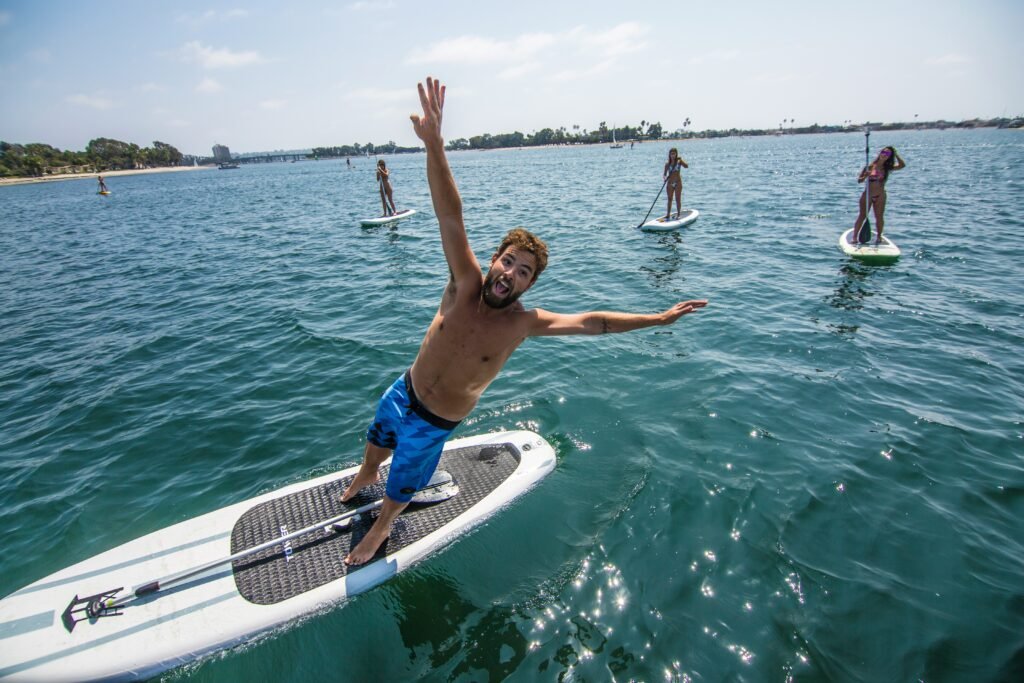
Is Paddle Boarding Actually Good Exercise?
Paddle boarding is good exercise because it asks your body to do several things at once. You are not only moving the paddle through the water. You are also standing on an unstable surface, adjusting your balance, rotating through your torso, and keeping your posture steady as the board responds to the water below you.
That combination makes SUP both a cardio and strength-based activity. At an easy pace, it can feel like light-to-moderate exercise. When you paddle continuously, increase your speed, or deal with wind and current, the intensity rises quickly.
The workout depends on how you use the board. A slow recreational paddle on calm water will not feel the same as a fast fitness paddle, an interval session, or a long-distance route. But even a relaxed paddle still requires more control than many people expect because the board never stays completely still.
This is why paddle boarding works well for a wide range of fitness levels. Beginners can start slowly on calm water, while more experienced paddlers can use SUP for endurance training, interval work, balance drills, and cross-training.
If you are still deciding what type of board fits your goals, read our guide on how to choose a paddle board before turning SUP into a regular workout.
What Muscles Does Paddle Boarding Work?
Paddle boarding is often described as a full-body workout, but different muscle groups play different roles. Some muscles help you produce power, while others stabilize your body and keep you balanced on the board.
Core Muscles
Your core is one of the most important muscle groups in paddle boarding. Your abs, obliques, and deeper stabilizing muscles help keep your torso upright while the board moves underneath you.
The core also helps transfer power through the body during each paddle stroke. Good paddling technique is not just about pulling with your arms. It involves rotating through the torso and using your midsection to control movement. When you paddle on both sides of the board, your core helps manage that side-to-side rotation while keeping your balance steady.
This is one of the reasons paddle boarding can feel like a core workout even when you are not doing specific ab exercises.
Back and Shoulders
Your back and shoulders do much of the work during the paddle stroke. The upper back helps control the pulling motion, while the shoulders guide and stabilize the paddle as it moves through the water.
When your technique is strong, the larger muscles of the back help generate power. When your technique is poor, you may rely too much on your arms and shoulders, which can lead to early fatigue. That is why posture matters. Keeping your chest open, your back tall, and your movement controlled helps distribute the work more effectively.
Arms and Forearms
Your arms and forearms help control the paddle, but they should not be doing all the work. Your hands guide the shaft, your forearms manage grip, and your biceps and triceps assist during the pull and recovery phase of the stroke.
If your arms start burning very quickly, it may be a sign that you are paddling mostly with your upper body instead of using your torso and back. A better stroke feels more connected. The paddle enters the water, your torso rotates, your back engages, and your arms help guide the movement rather than forcing it.
Legs and Glutes
Your legs may not seem active at first because you are not running or jumping, but they are constantly working. Your quads, hamstrings, glutes, calves, ankles, and feet all make small adjustments to help you stay balanced.
A slight bend in the knees keeps your lower body engaged and lowers your center of gravity. This makes the board easier to control and helps your legs respond to small changes in the water. Choppy water, boat wakes, and wind make the lower body work even harder because the board becomes less predictable.
That constant stability work is one of the reasons paddle boarding is useful for balance, coordination, and functional strength.
Main Fitness Benefits of Paddle Boarding
Paddle boarding has several fitness benefits because it combines movement, balance, resistance, and outdoor exercise in one activity.
- It Builds Core Strength and Stability
One of the biggest paddle boarding benefits is core engagement. Your core works to keep you upright, support your posture, and help control each stroke. Even when you are paddling at an easy pace, your midsection is active because the board is always shifting slightly.
This does not mean paddle boarding will automatically give you visible abs. Like any form of exercise, results depend on consistency, effort, and overall lifestyle. But as a functional core workout, SUP can help improve stability, posture, and body control over time.
- It Improves Balance and Coordination
Paddle boarding trains balance in a very natural way. The board moves under your feet, and your body has to respond. Your feet, ankles, legs, hips, and core all work together to keep you steady.
This kind of balance training is useful beyond paddle boarding itself. Better balance can support other sports, improve movement confidence, and help you feel more coordinated in daily activities. For beginners, even learning to stand comfortably on the board is part of the workout.
- It Supports Cardiovascular Endurance
A steady paddle boarding workout can raise your heart rate and build endurance, especially when you paddle continuously for 20, 30, or 45 minutes. Longer routes help develop stamina, while faster bursts can make the session feel closer to interval training.
The intensity depends on your speed, technique, water conditions, and how often you stop. A relaxed session may feel light. A focused fitness paddle with minimal drifting can become a solid cardio workout.
- It Works the Whole Body Without High Impact
Paddle boarding is low impact compared with activities like running because there is no repeated pounding against the ground. That can make it appealing for people who want to stay active without putting as much stress on their joints.
Low impact does not mean effortless. Your body still works hard to stabilize, paddle, and control movement. The difference is that the challenge comes more from balance, resistance, and sustained effort than from heavy impact.
- It Builds Functional Strength
SUP can help build functional strength because it trains the body through real movement patterns. You rotate, stabilize, pull, balance, and adjust continuously. These are useful movements that connect strength with coordination.
It will not replace heavy resistance training if your goal is maximum muscle growth, but it can improve muscular endurance, posture, and whole-body control. For people who want athletic movement rather than a purely gym-based routine, paddle boarding can be a strong addition.
How Many Calories Can You Burn Paddle Boarding?
The number of calories burned during paddle boarding depends on your body weight, pace, water conditions, board type, wind, current, and session length. A relaxed paddle on calm water will burn fewer calories than a faster workout in choppy conditions.
While calorie burn varies widely, most recreational paddle boarders burn roughly 300 to 600 calories per hour depending on body weight, pace, and water conditions.
Instead of focusing on one exact number, it is more useful to think about workout intensity.
| Activity Level | What It Looks Like | Workout Intensity |
| Relaxed paddling | Slow pace on calm water | Light to moderate |
| Steady fitness paddle | Continuous paddling with good technique | Moderate |
| Interval paddling | Short hard efforts with easy recovery | Moderate to high |
| Choppy water or current | More balance and resistance required | Higher effort |
| SUP yoga or movement drills | Balance-focused exercises on the board | Strength and stability focused |
If your goal is fitness, the most important factor is not only how many calories one session burns. It is whether you paddle consistently, keep moving during your session, and gradually increase the challenge over time.
How to Make Paddle Boarding a Better Workout
A casual paddle can be enjoyable, but if you want more fitness benefits, you need to add some structure. Small changes can make a big difference.
Use Proper Paddle Technique
Good technique makes the workout more effective and helps reduce unnecessary strain. Keep your posture tall, use a relaxed grip, and rotate through your torso instead of pulling only with your arms.
Think of the paddle stroke as a full-body movement. Your core and back should help generate power, while your arms guide the paddle. This makes the movement smoother and helps you paddle longer without tiring too quickly.
Paddle Continuously Instead of Drifting
If you want a real paddle boarding workout, avoid stopping too often. Choose a safe route and paddle continuously for a set amount of time. Even 20 to 30 minutes of steady paddling can feel very different from a session where you paddle for a few minutes and drift for long breaks.
Add Intervals
Intervals are one of the easiest ways to increase intensity. You do not need anything complicated. Try this simple structure:
- 5 minutes easy paddling
- 1 minute faster paddling
- 2 minutes easy recovery
- Repeat 4 to 6 times
- Cool down at an easy pace
This helps build cardio fitness while keeping the session manageable for beginners.
Try Balance Drills
Balance drills can make SUP more challenging without needing to paddle harder. You can practice slow turns, controlled stance changes, kneeling-to-standing transitions, or gentle board movement drills.
The goal is control, not rushing. Move slowly and stay aware of your surroundings.
Use Conditions Carefully
Wind, current, and choppy water can make paddle boarding more intense, but they also increase risk. Beginners should not intentionally choose difficult conditions just to make the workout harder.
Start in calm, protected water. As your confidence improves, mild variations in water conditions can naturally make the session more demanding.
Track Time, Distance, or Effort
If you want to improve, track something. It can be time on the water, distance covered, number of intervals, or how hard the session felt. Tracking helps turn paddle boarding from a casual activity into a repeatable fitness routine.
This is where performance habits matter. Tracking time, distance, and consistency helps turn casual paddling into measurable progress. That mindset is central to Kotriton’s approach to water sports training, performance, and life around the water.
Many swimmers, surfers, rowers, and endurance athletes use paddle boarding as cross-training because it develops balance, core stability, and aerobic endurance without the repetitive impact of running. This combination makes SUP a useful training tool both on and off the water.
Paddle Boarding vs Other Workouts
Paddle boarding is not automatically better than every other workout. Its value comes from the way it combines balance, endurance, full-body movement, and outdoor enjoyment.
| Workout | Main Benefit | Impact Level | Best For |
| Paddle boarding | Balance, core, endurance, outdoor fitness | Low impact | Full-body recreational fitness |
| Running | Cardio endurance | Higher impact | Conditioning and calorie burn |
| Gym strength training | Muscle and strength building | Varies | Strength and hypertrophy |
| Swimming | Cardio and full-body conditioning | Low impact | Endurance and joint-friendly fitness |
| Kayaking | Upper-body endurance | Low impact | Seated paddling and touring |
If you want maximum strength, the gym is better. If you want pure swimming endurance, swim training is more direct. But if you want a low-impact outdoor workout that trains balance, core control, and endurance at the same time, paddle boarding is hard to beat.
Who Is Paddle Boarding a Good Workout For?
Paddle boarding can be a good workout for many different people because it is easy to adjust. You can keep it relaxed, make it more structured, or turn it into serious conditioning over time.
It is especially useful for:
- Beginners who want low-impact exercise
- People who dislike traditional gym workouts
- Swimmers, surfers, and water-sports athletes who want cross-training
- Recreational paddlers who want more structure
- People working on balance and core control
- Anyone who wants outdoor exercise that feels enjoyable
It may not be ideal to push too hard if you have shoulder, back, balance, or injury concerns. In that case, start gently, choose calm water, and consider professional guidance if needed.
The best approach is to build gradually. Learn control first, then increase time, distance, and intensity.
Safety Tips Before Turning Paddle Boarding Into a Workout
Before treating SUP as a workout, make sure you can paddle safely. Fitness should never come before control, awareness, and basic water safety.
- Use a leash so the board stays connected to you
- Wear a personal flotation device where appropriate or required
- Check wind, weather, current, and tide before launching
- Start in calm, protected water
- Avoid paddling alone as a beginner
- Dress for the water temperature, not only the air temperature
- Bring water, sun protection, and a phone in a waterproof case
- Learn how to fall safely and get back on the board
- Avoid intense training until you can control the board confidently
If you want to connect with other water-sports athletes, training-minded paddlers, and people building a lifestyle around water, explore the Kotriton community.
How Often Should You Paddle Board for Fitness?
For beginners, one to two paddle boarding sessions per week is a good starting point. This gives your body time to adapt while helping you build comfort on the board.
A simple progression can look like this:
- Weeks 1–2: short, easy paddles on calm water
- Weeks 3–4: longer steady paddles with fewer breaks
- Week 5 onward: add intervals, technique goals, or longer routes
As you improve, you can use paddle boarding as part of a broader training routine. It can pair well with swimming, mobility work, strength training, or recovery days.
The goal is not to make every session hard. The goal is to paddle consistently and improve your control, endurance, and confidence over time.
For more performance-focused ideas and water-sports training direction, visit the Kotriton Lab.
Frequently Asked Questions
Is paddle boarding good for weight loss?
Paddle boarding can support weight loss when it is done consistently and combined with healthy nutrition and overall activity. The number of calories burned depends on your pace, body weight, water conditions, and session length.
Is paddle boarding cardio or strength training?
Paddle boarding can be both. Easy paddling is mostly light cardio and balance work, while faster paddling, intervals, and rougher conditions increase cardio and strength demands. It is especially useful for muscular endurance and core stability.
Does paddle boarding work your abs?
Yes. Your abs and obliques help stabilize your body and support torso rotation during each paddle stroke. The core works even harder when the water is moving or when you paddle with better technique.
Does paddle boarding build muscle?
Paddle boarding can build functional strength and muscular endurance in the core, back, shoulders, arms, legs, and glutes. It can help tone and condition the body, but it is not a direct replacement for weight training if your goal is major muscle growth.
Is paddle boarding good for beginners?
Yes. Paddle boarding can be beginner-friendly when you start on calm water with a stable board and proper safety gear. Beginners can kneel first, then stand as balance improves.
How long should a paddle boarding workout be?
Beginners can start with 20 to 30 minutes. As confidence improves, you can build toward 45 to 60 minutes or add short intervals to increase intensity.
Is paddle boarding better than kayaking for fitness?
Paddle boarding usually challenges balance, legs, and core more because you are standing on the board. Kayaking is seated and tends to focus more on upper-body endurance. Both can be good workouts, but they train the body differently.
Conclusion
Paddle boarding is a good workout because it combines core stability, balance, muscular endurance, cardio, and outdoor movement. It can be relaxed enough for beginners, but it can also become more challenging as you increase your pace, distance, or training structure.
One of the biggest reasons people stick with paddle boarding is that it delivers meaningful fitness benefits without feeling like a traditional workout. You are moving through water, building control, and spending time outside while your body works in the background. For people who want exercise that feels less repetitive and more connected to the water, paddle boarding can be a strong part of a long-term fitness routine.