
Table of Contents
Swimming drills work best when they solve a specific problem.
Doing random drills for hundreds of meters may make a workout look technical, but it does not guarantee that your normal stroke will improve. A useful drill should isolate one part of your technique, help you feel a better movement, and then transfer that movement back into full-stroke swimming.
So, before choosing a drill, identify what is actually slowing you down.
| If You Struggle With… | Try This Drill |
| Sinking hips or poor alignment | Streamline kick |
| Poor body rotation | 6-1-6 drill |
| Weak feel for the water | Sculling |
| Ineffective pull | Fist drill |
| One arm working differently | Single-arm freestyle |
| Tense or awkward recovery | Fingertip drag |
| Poor stroke timing | Catch-up drill |
| Breathing that disrupts alignment | Side-kick breathing |
| Kicking too much from the knees | Rotator kick |
| Balancing speed and efficiency | Swim golf |
If you are looking to build strength and agility as a swimmer, our guide on dryland training for swimmers will be a helpful resource for you.
1. Streamline Kick Drill
Best for: Body position and reducing drag
Push off the wall with both arms extended overhead, one hand over the other, and your head between your arms. Keep your body long while performing a controlled flutter kick.
Avoid lifting your head to look forward. A raised head can cause your hips and legs to sink.
What to feel: Your body moving as one long line rather than bending through the middle.
Transfer it: Swim 25 meters of streamline kick, followed by 25 meters of normal freestyle while keeping the same long body position.
2. 6-1-6 Drill
Best for: Rotation, balance, and body alignment
The 6-1-6 drill is one of the most useful freestyle drills for swimmers who stay too flat in the water.
Kick six times while lying on one side with the lower arm extended forward. Take one complete freestyle stroke to rotate onto the opposite side, then kick six times again.
Rotate from your hips and torso rather than forcing the movement from your shoulders.
What to feel: Balanced on your side with your body still long and controlled.
Transfer it: Follow each drill length with normal freestyle and keep a smaller, natural version of the same rotation.
3. Sculling Drill
Best for: Improving your catch and feel for the water
Sculling teaches you to feel pressure against your hands and forearms.
Start with your arms extended slightly below the surface. Bend your elbows gently and sweep your hands inward and outward using small movements while keeping consistent pressure on the water.
Do not worry about moving quickly. Sculling is intentionally slow.
What to feel: Continuous pressure on your palms and forearms instead of your hands slipping through the water.
Transfer it: Perform 15–25 meters of sculling, then swim freestyle while trying to recreate that pressure at the beginning of each pull.
4. Fist Drill
Best for: Using your forearm during the pull
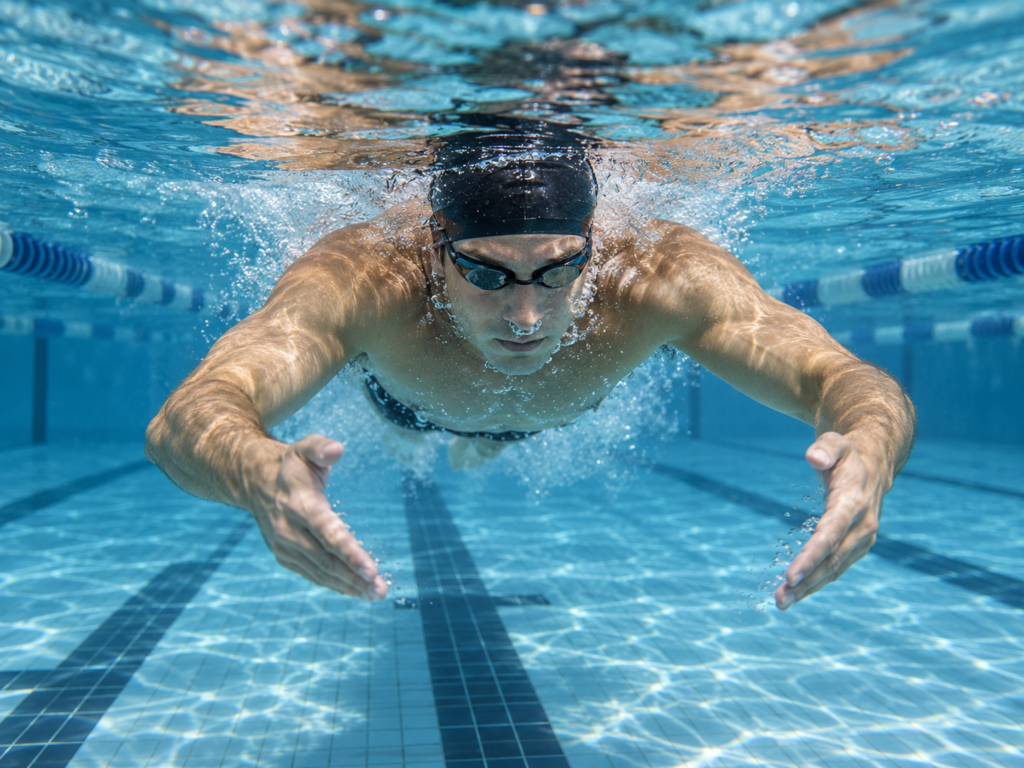
Swim normal freestyle with both hands gently closed into fists.
Removing most of the surface area of your hands forces you to pay more attention to your forearms during the catch and pull.
Keep your stroke controlled rather than increasing your turnover to compensate.
What to feel: Pressure along your forearms, not only at the end of your arms.
Transfer it: Alternate 25 meters with fists and 25 meters with open hands. The open-hand length should make the connection with the water feel noticeably stronger.
5. Single-Arm Freestyle
Best for: Catch mechanics, symmetry, and body control
Swim using one arm while the other remains extended in front or rests alongside your body.
Focus on one complete stroke at a time: entry, catch, pull, recovery, rotation, and breathing.
If one side feels much less controlled than the other, this drill can help expose the difference.
What to feel: A clean hand entry and controlled pull without crossing your body’s centerline.
Transfer it: Do 25 meters with your right arm, 25 with your left, then 25 meters of full freestyle while keeping both sides as similar as possible.
6. Fingertip Drag Drill
Best for: Relaxed recovery and hand entry
The fingertip drag drill is simple: during freestyle recovery, allow your fingertips to skim lightly across the surface of the water as your hand moves forward.
Keep your shoulder relaxed and elbow comfortably higher than your hand.
Do not force an exaggerated high elbow. The purpose is a smooth, relaxed recovery rather than copying one rigid arm position.
What to feel: Relaxation through the shoulder and arm.
Transfer it: Swim one drill length followed by one normal freestyle length while keeping the same easy recovery.
7. Catch-Up Drill
Best for: Stroke timing and awareness
Begin swimming freestyle, but keep your front arm extended until the recovering hand nearly reaches it. Then begin the next stroke.
This exaggerates the front end of the stroke so you can focus on completing one movement at a time.
Avoid turning catch-up into your permanent swimming style. Waiting too long between strokes can create a dead spot and reduce momentum.
What to feel: Control and awareness of where each stroke begins.
Transfer it: Try 25 meters catch-up followed immediately by 25 meters normal freestyle with a smoother, more continuous rhythm.
8. Side-Kick Breathing Drill
Best for: Breathing without lifting your head
Kick gently while lying on your side. Keep your lower arm extended and your upper arm alongside your body.
Your face should remain mostly in the water. When you need air, rotate your head with your body rather than lifting it upward.
Poor breathing mechanics often affect more than breathing itself. Lifting your head can disturb alignment and cause your hips to drop.
What to feel: Your mouth reaching the air through rotation rather than by raising your head.
Transfer it: Follow with easy freestyle and focus on keeping one goggle close to or in the water during the breath.
9. Rotator Kick Drill
Best for: Kick mechanics and rotation from the hips
Start kicking on your front with both arms alongside your body.
After several kicks, rotate onto one side using your hips and core. Kick briefly in that position, rotate back to the front, and then repeat to the opposite side.
Keep the kick compact. Excessive bending at the knees can increase resistance without giving you much useful propulsion.
What to feel: The rotation beginning through your torso and hips while your kick continues smoothly.
10. Swim Golf
Best for: Stroke efficiency and speed
Swim golf combines your time and stroke count into one simple score.
Swim a set distance, such as 25 or 50 meters. Count your strokes and record your time in seconds.
For example:
25 seconds + 18 strokes = score of 43
Repeat the distance and try to lower the score without sacrificing technique.
The goal is not simply to take fewer strokes. Taking extremely long, slow strokes may reduce your stroke count while also making you slower. Instead, look for a balance between stroke length and speed.
What to feel: Efficient movement without rushing or over-gliding.
Transfer it: Repeat the test periodically under similar conditions and track whether your time improves at a comparable stroke count.
Best Swimming Drills for Beginners
If you are new to technique work, you do not need all ten drills in one session.
Start with:
- Streamline kick
- Side-kick breathing
- Catch-up
- Fingertip drag
- Single-arm freestyle
These swimming drills for beginners focus on basic alignment, breathing, timing, and stroke awareness before moving into more detailed catch work.
Choose one or two problems at a time. Trying to consciously change your head position, kick, catch, recovery, and breathing in the same session usually makes it harder to learn any of them well.
Before starting technique work, prepare your shoulders, upper back, hips, and core with our swimming warm-up exercises.
How to Add Swimming Drills to a Workout
Drills should support normal swimming rather than replace it.
A simple technique session could look like:
- 200m: Easy warm-up
- 4 × 25m: Selected drill
- 4 × 50m: 25m drill + 25m normal swimming
- Main set: Normal swimming with one technical cue
- 100m: Easy cool-down
The important part is the drill-to-swim transition.
If you perform perfect sculling but immediately return to slipping through the water during freestyle, the drill has not yet transferred to your stroke.
This is why alternating short drill repetitions with normal swimming can be more useful than spending hundreds of meters doing the drill alone.
How Do You Know if a Swimming Drill Is Working?
Do not judge a drill only by whether it feels difficult.
Look for a change in your normal stroke.
You can track:
- Time over the same distance
- Stroke count
- Body position
- How easily you maintain technique
- Differences between your left and right sides
- Video of your swimming
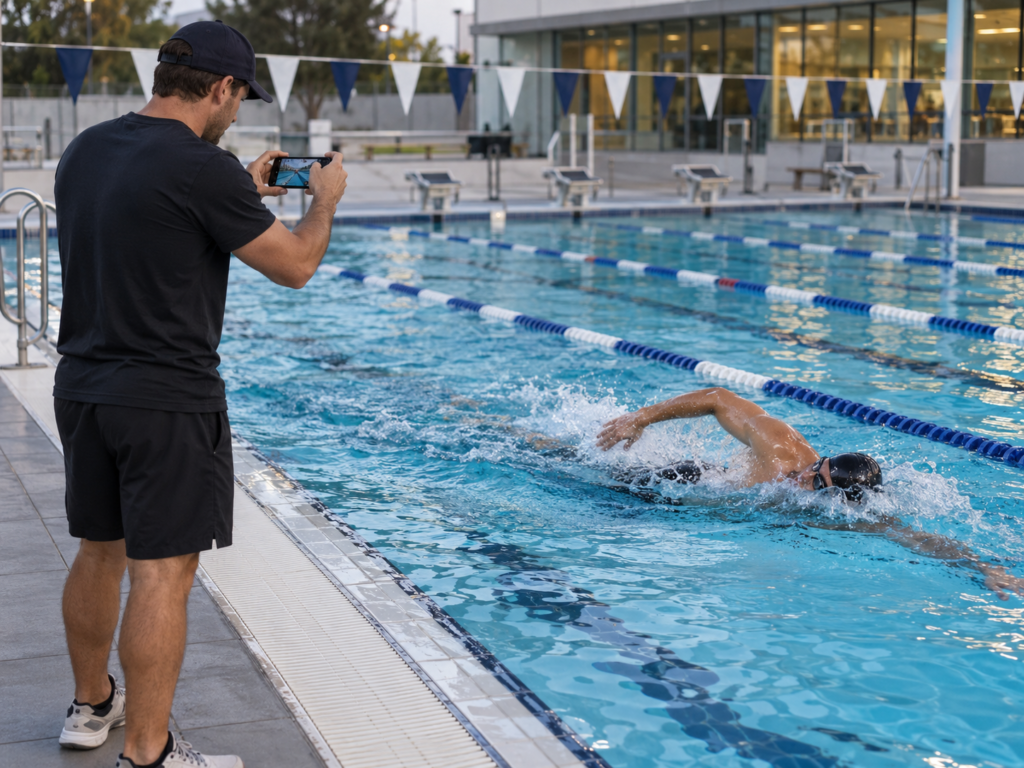
Video can be particularly helpful because what a movement feels like and what it actually looks like are not always the same. A PubMed-indexed study of front-crawl swimmers found benefits from self-observation for motor learning, particularly among beginner swimmers.
Film the same short section of your stroke every few weeks under similar conditions. The goal is not to look perfect; it is to see whether the specific problem you are training is improving.
Common Swimming Drill Mistakes
Choosing drills randomly. Pick the drill that matches the problem you are trying to solve.
Going too fast. Most swim technique drills work better when you slow down enough to control the movement.
Doing too many drills. One or two focused drills usually provide more useful feedback than cycling through ten in one workout.
Never returning to full stroke. The objective is better swimming, not becoming excellent at drills.
Repeating poor technique. If you are unsure whether you are performing a drill correctly, use video or ask a qualified coach for feedback.
Frequently Asked Questions
How often should I do swimming drills?
A small amount of focused drill work can be included regularly, particularly early in a session when you are fresh. The exact frequency depends on what you are trying to fix and how quickly the change transfers into your normal stroke.
What are the best freestyle drills?
Useful freestyle swimming drills include 6-1-6 for rotation, sculling for the catch, fist drill for forearm engagement, fingertip drag for recovery, catch-up for timing, and single-arm freestyle for symmetry and stroke awareness.
Can swimming drills make you faster?
Yes, when poor technique is limiting your speed. Drills can help improve how you move through the water, but they need to transfer back into full-stroke swimming. For a broader look at technique, strength, turns, and other speed limiters.
How many drills should I do in one workout?
Usually one to three focused drills are enough. Choose them based on your current technical priorities rather than trying to fit every drill into the same session.
Final Thoughts
The best swimming drills are not necessarily the hardest or most advanced. They are the ones that address a real problem in your stroke and create a change you can carry into normal swimming.
Start by identifying what needs work. Choose one or two drills, perform them carefully, return to full stroke, and measure whether the change actually improves your swimming.
For more practical swimming and water-sports performance guides, explore the Kotriton Journal or visit Kotriton to learn more about the brand and its water-sports training focus.